Home Page - Actigraphy
Main menu:
Actigraphy analysis project log
June 2022 Pre print.
Gianluigi G. Delucca. 2022. “ Motionwatch8 Wrist Activity and Light Analysis: from ambulatory recording toward real life monitoring.” OSF Preprints. June 24. https://doi.org/10.31219/osf.io/cdqxh
May 2021 Pre print.
delucca, gianluigi. 2021. “Motionwatch8 Wrist Actimetry Data Analysis: From Ambulatory Recording to Real Life Monitoring.” OSF Preprints. May 13. https://doi.org/10.31219/osf.io/pdctj
March April 2021
Co recording of Core temperature, Wrist actigraphy and HR in order to document the winter-summer time change. From Thursday March 25 until Tuesday April 6. Unfortunately the HR recording was not good.
End of 2020.
The continous one second wrist actigraphy recording is stopped. There are now 5 years of data that are a meaningful starting point for the analysis that was planned in 2015.
July 2020 - Additional raw data of four months of continous one channel EKG and chest actigraphy in real life, as described here and below.
July 2019 - Expanded article "Wrist Actigraphy Analysis From Motionwatch8 Data" http://www.thinkmind.org/index.php?view=article&articleid=lifsci_v11_n12_2019_8
September 2018 - SensorDevice2018. Conference presentation on Phase 2&3
August 2018 - Raw data of Subproject 1- Phase 2&3 - are available at https://sleepdata.org/datasets/oya
August 2017 - Some additional details: First year report - Phase I & II
January 2017 - While dataset develops, some rough evaluations are possible: Project PhaseIII report
The start of the project: 2015
This project is looking for new ways of sleep/circadian data analysis.
The main target is to search for predictive algorithms from wrist actigraphy recordings of one subject using a MotionWatch8 (CamNtech Ltd) system on the non predominant wrist, for unrestricted lifestyle.
The context
Wrist actigraphy has been used in the past 30 years to monitor motion activity.
The actigraphy data have been accepted for the analysis of sleep of a single night, with a quantification of sleep duration and its fragmentation.
They are also used to check the presence of fluctuations in the circadian cycle, especially to highlight pathologies with shifts of falling asleep timing.
During the day it is possible to quantify exercise and (with calibration) recognize type and intensity of the exercise.
Continuous monitoring of wrist actigraphy in real life is possible and it is a valuable tool.
Nowadays, the needed hardware is cheap and it is possible to imagine useful applications in real life, for continuous monitoring and smart homes.
There are dozens of startups with wearable monitors based on actigraphy that use more or less the same parameters for recording and analysis of one minute epochs. And then, they make the comparison against a(nother) so called "normal" group they built for the occasion, frozen in time and space.
New models and algorithms need long term data sets and guidelines on methodological issues. It seems that both are not easily available, on and off line.
Some examples are available in partially controlled environments:
- Nearly 600 days in 2 patients
Werth, Esther, Egemen Savaskan, Vera Knoblauch, Paola Fontana Gasio, Eus J.W. van Someren, Christoph Hock, Anna Wirz-Justice. Decline in long-term circadian rest-activity cycle organization in a patient with dementia. J Geriatr Psychiatry Neurol, 2002; Vol. 15; pp. 55-59.
- 50 days and then 30 days after 5 months
Miller, Nita Lewis, Shattuck, Lawrence, G. Sleep Patterns of Young Men and Women Enrolled at the United States military Academy: Results from Year 1 of a 4-Year Longitudinal Study. Sleep, 2005; Vol. 28; No. 7; p. 837.
- One month twice a year for 4 years
Longitudinal Study of Sleep Patterns of United States Military Academy Cadets Nita Lewis Miller, Lawrence G. Shattuck, Panagiotis Matsangas Sleep. 2010 December 1; 33(12): 1623–1631.
- 6 months sea duty Nita Lewis Shattuck ; Panagiotis Matsangas A 6-Month Assessment of Sleep During Naval Deployment: A Case Study of a Commanding Officer. Aerospace medicine and human performance Vol. 86, No. 5 May 2015
Few recordings are available in free life:
- 5 months, one patient
Garbazza C, Bromundt V, Eckert A,Brunner DP, Meier F, Hackethal S and Cajochen C (2016) Non-24-Hour Sleep-Wake Disorder Revisited – A Case Study. Front. Neurol. 7:17. doi: 10.3389/fneur.2016.00017
- 4 months, 80 OSA patients and 50 controls.
Sleep remains disturbed in patients with obstructive sleep apnea treated with positive airway pressure: a three-month cohort study using continuous actigraphy Sleep Medicine, Volume 24, August 2016, Pages 24-31 Jon Tippin, Nazan Aksan, Jeffrey Dawson, Steven W. Anderson, Matthew Rizzo
- And the amazing 30 years!
ESRS 2016 Bologna
P041 Three decades of continuous motor activity recording:analysis of sleep duration
A. Borbely, T. Rusterholz and P. Achermann Institute of Pharmacology and Toxicology, University of Zurich, Zurich, Switzerland
Objectives: Motor activity recording by a wrist-worn device is a common unobtrusive method to monitor the rest-activity cycle. We present a first analysis of data that have been obtained over more than three decades.
The dataset
To answer to the need of a suitable data set, I started one long term recording on myself, late 2015. Since it is expected from physiology to find rhythms with a period long at least one year, a recording with a minimum length of two years is today the first target.
The goal
Existing analysis methodologies for wrist actigraphy, describe the recorded data but do not provide any personal parameter, I mean something that alert or reassures about your body status, at least for the coming day, as well as we do for Temperature or Blood pressure measurements.
On the contrary, I think that for personal monitors we need personal parameters, that "grow old" with the subject, in his own way.
I think that for such parameters, we need to create data models and develop algorithms that use Artificial Intelligence.
Hopefully, the analysis of the long term, high sampling data of subproject 1 will allow researchers to find at least one parameter that will be possible to use. Anyway, even if that search fails, the need of the one second epoch in this field of studies is bubbling, and that recording will be useful.
The possible analysis will be tied to the lenght of the recording, but also on the models that will be invented for this new type of recording. It is something that need more than one research center and therefore the idea is to make the first year at one second epoch (Phase 2 and 3) available to the public.
Sub-project 1 - MW8 dataset
Sub-project 1 – Dataset – Phase I
That was the baseline. Six months at 1 minute epoch. Start date 17/12/2015
Sub-project 1 – Dataset – Phase II . Start of the dataset: 17/06/2016
Six months at 1 second epoch.
Sub-project 1 – Dataset – Phase III
Six months at 1 second epoch. Environnement change: ligh only wake up clock stopped. It was set at 7.00, at about 3 meters from the head.
Sub-project 1 – Dataset – Phase IV
Six months at 1 second epoch. In case of early morning (4 to 6 a.m) wake up, most of the time an eye mask is then used.
Sub-project 1 – Dataset – Phase V
Six months at 1 second epoch. It is the last Phase needed to reach the minimun of 2 years continous regording at 1 sec.
At the moment it is not known what should be a "sufficient" lenght of such a recording, since it is the first set ever recorded, I think it should go ahead as long as possible, because it will show in one subject the change over time that is expected from short recordings in groups of different ages described in literature.
Sub-project 2 – Activity & EKG dataset
A test of 5 days using an Actiheart, shows that the EKG behaviour is not as "normal", as expected.
The high/low HR day/night cycle is respected, but there are too many variations during the night that do not seem to be simple artifacts.
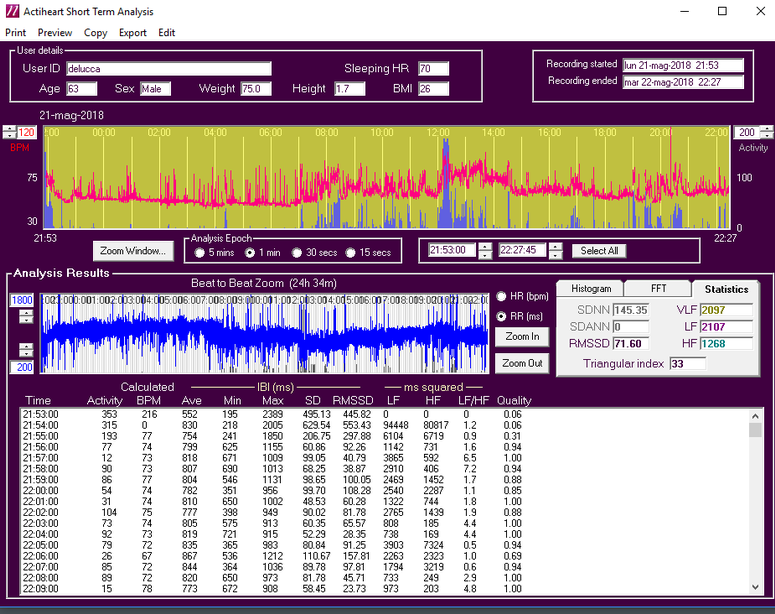
Therefore a new subproject starts with the co-recording of wrist actigraphy with the Motionware8 and one ActiwaveCardio..
The Actiwave Cardio was selected against the Actiheart because it is able to record the full ECG plus position, and that is more suitable for the type of research of this project than the simple HR available with the Actiheart.
The memory of the Actiwave Cardio will require a daily download, but that is already needed for the Motionwatch8.
Subproject 2 - Recording Log
Recording mode ECG is 128Hz, 8 bits, Acceleration 3 axis sampled at 32Hz.
That setting allows nearly the same recording time of the Motionwatch8.
Phase I - Start day 19/06/2018
Month 1 - Closed This month was spent trying to set a suitable protocol.
The most difficult part is the electrodes management. The position is important for low artifacts and a good automated analysis, the glue will bring skin stress. Then the recorder memory and battery use must be optimised.
At the moment I'm using two Actiwave Cardio with systems and electrode change each 12 hours. Recording mode for ECG is 256 Hz, 10 bits; Acceleration 3 axis sampled at 32Hz.
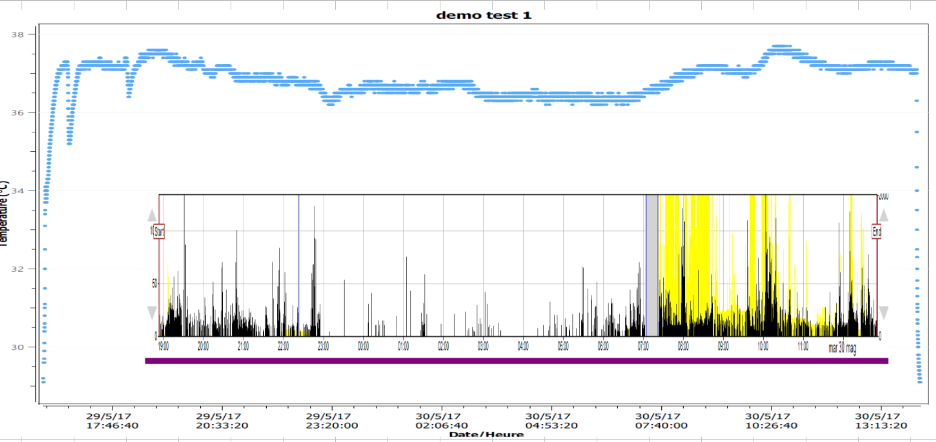
3 days of core temperature monitoring
Month 2 - Closed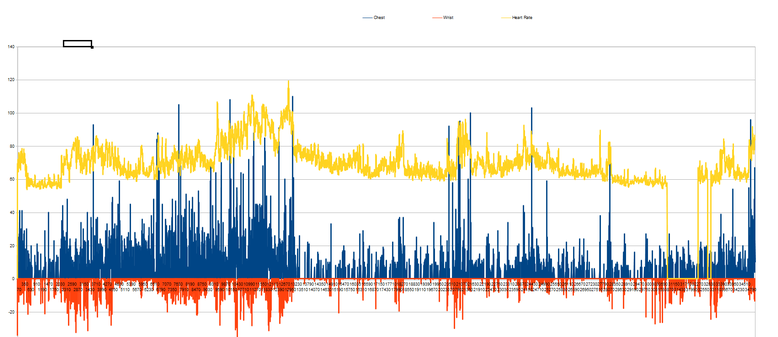
Example of one day from 8 a.m. to 6 p.m.
Yellow HR, Blue Movement chest (counts), Red Movement Wrist (Counts, reversed for a better display).
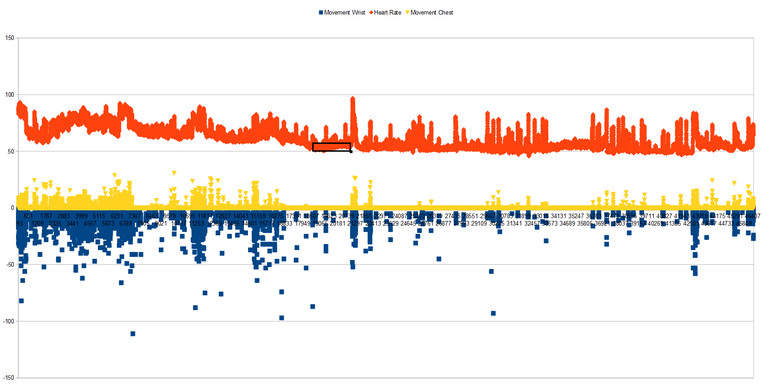
From 7 p.m. to 8 a.m.
Red HR, Yellow Movement chest (counts), Blue Movement Wrist (Counts, reversed for a better display).
Only 10 days were possible for the recording. The mix of hot temperature and sweat brought a large sensitised area and I was forced to stop. The reecovering of the skin is slow.
While the skin recover, I started a recording with two actigraphs on the same wrist. The goal is to get a range of variability due to the differences in system calibration and position. It is not a perfect test due to the interaction of the two systems, but will provide a dimension of the issue. It is now 10 days and I'll try to reach 30.
Month 3 - Closed
A total of 36 days has been recorded with 2 units on the same wrist.
A new start for the Motionwatch8 (MW8) and ActiwaveCardio(AWC) co recording is planned for October.
During this month it was possible to record a very long day immobility phase (3 hours) on the dentist chair under the effect of 10 drops of Lexotan (Bromazepam) and local anesthetics.
Month 4 - Closed
Motionwatch8 (MW8) and ActiwaveCardio(AWC) co recording started October 7.
Two Actiwave Cardio with systems and electrode change each 24 hours. Recording mode for EKG is 128 Hz, 8 bits; Acceleration 3 axis sampled at 32Hz.
The first ten days went smoothly and hopefully it will cover the change to solar time on October 26.
Month 5 - Closed
I'll try to meausre temperature as regularly as possible with a standard mercury thermometer as a background for a core temperature telemetric recording around October 26, the change from winter to solar time.
The co-recording ended at the end of October due to skin sensitation.
Month 6 - Partial - Closed
Unfortunately, the MW8 unit was lost at the end of November. The Phase is then closed and a new one is started with the unit. used for co-recording during Month 2.
Phase II - Start day 1/12/2018
Actigraphy recording keep going and a new EKG start is planned for 2019.
Month 1 - Closed
Month 2 - Closed
Month 3 - Closed
Month 4 - Closed Change of local time, +1 from the first 3 months
Month 5 - Closed
Month 6 - Closed
Month 7 - Closed
Month 8 - Closed at June 19
Phase III - Start day 19/06/2019
Month 1 - Closed - Start of a new EKG recording on June 24 - EKG recording had to stop after few days due to wheather too hot and sudoration
did not allowed electrode stability.
Month 2 - Closed
Month 3 - Closed
Month 4 - Closed - Start of a new EKG recording on September 30
Month 5 - Closed - Back to standard time-
Month 6 - Closed
Month 7 - Closed
Month 8 - Closed - Intermittent fasting for one month starting January 1. Includes one week at EKG at 256 Hz and another at 512 Hz
Month 9 - Closed - Skin sensitation and pause of the EKG recording on February 3.
Month 10 - Closed - Restart EKG on February 20 but new stop on February 29 for a new, stronger sensitation.
Phase IV - Start day 22/03/2020
Month 1 - Start of the experiment of co-recording of wrist actigraphy, EKG with chest actigraphy and core temperature. The target of the experiment is to document the week before and the week after the change of time on the night between 27 and 28 March.
Due to COVID19 the social interactions are limited and it is possible to keep a better documentation of the daily activities.
27-3-2020 - Unfortunately, after two days the skin reacted with a bad cutaneous rush and the experiment had to end. To be reprogrammed at the end of September....
Month 2 - Closed
Month 3 - Closed
Month 4 - Closed
Month 5 - Closed
Month 6 - Closed
Month 7 - Closed .Due to illness, it was not possible to perform the co-recording
Month 8 - Closed
Month 9 - Closed
Below:
Example of simultaneous 24 hours recording of core temperature, actigraphy and light. Five seconds sampling rate.